When choosing protective clothing for welding and industrial work, it is important to understand what the different standards actually mean. A garment may comply with several standards at the same time, with each standard covering a different type of hazard.
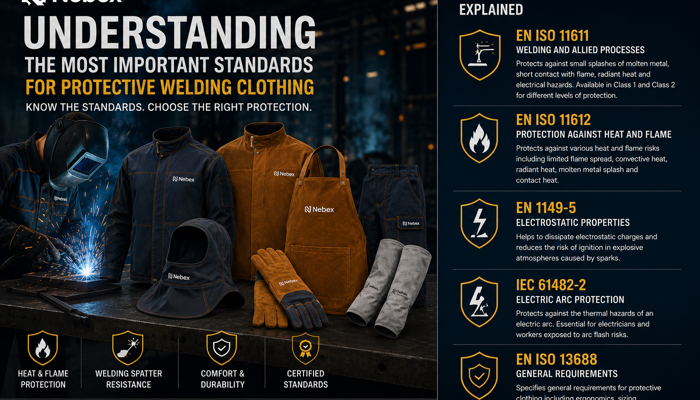
EN ISO 11611 – Protective clothing for welding and allied processes
EN ISO 11611 is the main specific standard for clothing designed for welding and related processes.
It specifies requirements for protective clothing intended to protect the wearer against:
- small splashes of molten metal
- short contact with flame
- radiant heat
- heat from welding processes
- electrical hazards under specified test conditions
The standard divides welding clothing into Class 1 and Class 2, depending on the level of protection required.
Class 1 is intended for less hazardous welding situations, while Class 2 provides a higher level of protection for more demanding welding conditions.
If you are specifically looking for welding protective clothing, EN ISO 11611 is one of the most important standards to check.
EN ISO 11612 – Clothing to protect against heat and flame
EN ISO 11612 is a broader standard for protective clothing designed to protect the wearer against heat and flame.
Unlike EN ISO 11611, it is not specifically limited to welding.
It covers protection against different forms of heat and flame exposure, depending on the certified performance of the garment.
The standard includes several performance codes, for example:
- A1 / A2 – limited flame spread
- B – protection against convective heat
- C – protection against radiant heat
- D – protection against molten aluminium
- E – protection against molten iron
- F – protection against contact heat
The individual letters are accompanied by performance levels. Therefore, a garment marked EN ISO 11612 A1 B1 C1 provides different protection than one marked EN ISO 11612 A1 A2 B1 C2 E3.
For this reason, it is important to look at the complete marking, rather than simply seeing "EN ISO 11612" and assuming that all garments offer the same level of protection.
EN ISO 11612 is particularly relevant for workers exposed to heat and flame in industries such as metal processing, foundries, welding, manufacturing and maintenance.
EN 1149-5 – Electrostatic properties
EN 1149-5 relates to the electrostatic properties of protective clothing.
Its purpose is to ensure that clothing designed with electrostatic dissipative properties can help reduce the accumulation of electrostatic charges on the garment under specified conditions.
This is particularly important in environments where electrostatic discharge could create a safety risk, for example where flammable gases, vapours or dusts may be present.
EN 1149-5 should not be confused with electrical protection against electric shock.
In other words:
EN 1149-5 = electrostatic charge dissipation
It does not mean:
protection against electric shock.
Protective clothing certified according to EN 1149-5 may therefore be an important part of an overall PPE system in potentially explosive or electrostatically sensitive environments, when the risk assessment requires it.
IEC 61482-2 – Protection against thermal hazards of an electric arc
IEC 61482-2 covers protective clothing intended to protect against the thermal hazards of an electric arc.
This is particularly important for electricians and workers who may be exposed to an arc flash during electrical work.
An electric arc can generate extremely high temperatures and intense thermal energy within a very short period of time. Ordinary flame-retardant workwear should therefore not automatically be considered suitable for arc-flash protection.
IEC 61482-2 is a product standard specifying requirements for protective clothing against the thermal hazards of an electric arc.
When selecting clothing for arc-flash protection, it is important to look at the complete certification and performance information, rather than simply looking for the standard number.
Commonly associated test methods and performance information include:
- IEC 61482-1-1 – Open Arc Test
- IEC 61482-1-2 – Box Test
The results can be expressed using parameters such as ELIM, ATPV or APC, depending on the applicable test method and product documentation.
This standard is therefore especially relevant for electrical maintenance, power distribution, switchgear and other work where an arc-flash risk has been identified.
Welding Clothing: Which Standard Covers Which Hazard?
A simple way to understand the standards is:
Standard - Main purpose - Typical hazard
EN ISO 11611 - Protective clothing for welding - Welding spatter, molten metal, heat and flame
EN ISO 11612 - Protection against heat and flame - Heat, flame and thermal exposure
EN 1149-5 - Electrostatic properties - Electrostatic charge accumulation
IEC 61482-2 - Protection against electric arc thermal hazards - Arc flash / thermal effects of an electric arc
EN ISO 13688 - General requirements for protective clothing - General design, ergonomics, sizing and marking
Why can one garment have several standards?
A professional protective garment may be designed to protect against several different hazards at the same time.
For example, a flame-retardant garment used in industrial environments may be certified according to EN ISO 11612, EN 1149-5 and IEC 61482-2, depending on its intended application and testing.
A welding jacket may additionally be certified according to EN ISO 11611.
This does not mean that one standard replaces another. Each standard addresses a specific hazard or group of hazards.
The correct choice should therefore always be based on the actual risks present at the workplace and the employer's risk assessment.
The most important rule: check the complete certification
When purchasing protective clothing, do not select a garment simply because it says "flame retardant" or because it carries one familiar standard.
Always check:
- Which standards does the garment meet?
- Which performance classes or levels are specified?
- Is the garment suitable for the specific welding or industrial process?
- Does the complete PPE system provide the protection required by the workplace risk assessment?
The right protective garment is not necessarily the one with the largest number of standards on the label. It is the garment whose certified protection matches the actual hazards of the job.