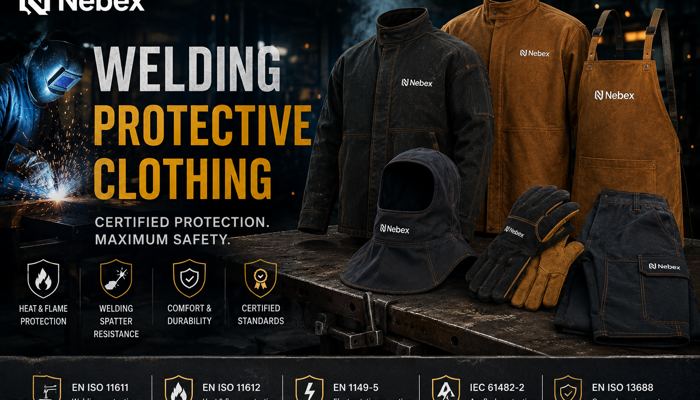
Welding is one of the most demanding industrial activities when it comes to personal protective equipment. Welders are exposed to sparks, molten metal, welding spatter, radiant heat, flames and, depending on the application, additional mechanical and environmental hazards. A suitable welding helmet is essential, but eye and face protection alone is not enough. Proper welding clothing is an important part of the overall PPE system, protecting the body against heat, flames and welding spatter while allowing the welder to work safely and comfortably. At Evermatic, we offer a range of welding protective clothing and accessories designed for different welding applications – from lightweight garments for everyday welding to heavy-duty leather protection for demanding industrial work.
What should welding clothing protect against?
During welding, the most common hazards include:
- welding sparks and spatter
- molten metal droplets
- flames and heat
- radiant heat
- short-term contact with hot materials
- mechanical stress and abrasion
- heat generated during grinding and related operations
The level of protection required depends on the welding process, welding position, intensity of the work and the surrounding environment.
For example, a welder performing occasional TIG welding may have very different requirements from a professional MIG/MAG welder working continuously in heavy fabrication.
This is why choosing welding clothing based only on price or material is not enough. The garment should be selected according to the actual risks of the job.
EN ISO 11611 – The key standard for welding clothing
One of the most important standards when selecting protective clothing for welders is EN ISO 11611 – Protective clothing for use in welding and allied processes.
This standard specifies minimum basic safety requirements and test methods for protective clothing intended to protect the wearer during welding and related processes.
A garment certified according to EN ISO 11611 is tested for properties relevant to welding hazards, including protection against:
- small splashes of molten metal
- short contact with flame
- radiant heat
- electrical resistance
- heat transfer under specified test conditions
EN ISO 11611 also defines different protection classes.
Class 1
Class 1 provides protection against less hazardous welding situations and is generally intended for welding techniques and situations producing lower levels of spatter and radiant heat.
Class 2
Class 2 provides a higher level of protection and is intended for more hazardous welding conditions, including situations with greater amounts of welding spatter and radiant heat.
For example, the Rhinoweld JK269 welding jacket available from Evermatic is CE approved according to EN ISO 11611:2015. It combines heavy-duty split leather on the chest and sleeves with flame-retardant fabric on the back, providing a balance between protection and comfort.
Another example is the Weldas Lava Brown™ welding jacket, which is tested to EN ISO 11611:2015 Class 2/A1+A2. It is made from A-grade split cow leather and uses KEVLAR® stitching.
What do A1 and A2 mean?
When looking at EN ISO 11611 markings, you may also encounter designations such as A1 and A2.
These relate to the way the material is tested for limited flame spread.
In simple terms, they indicate different ignition configurations used during testing. They are therefore not alternative "protection classes" in the same sense as Class 1 and Class 2.
The important point for the user is to look at the complete certification marking, rather than focusing on one individual code.
EN ISO 13688 – General requirements for protective clothing
Another important standard is EN ISO 13688 – Protective clothing – General requirements.
Unlike EN ISO 11611, this is not a welding-specific protection standard. It establishes general requirements for protective clothing, including aspects such as:
- ergonomics
- sizing and fit
- innocuousness of materials
- garment marking
- information supplied by the manufacturer
- general design requirements
For welding clothing, EN ISO 13688 is normally used together with a specific protective clothing standard such as EN ISO 11611.
Therefore, when selecting welding clothing, it is important to distinguish between general requirements and the specific protection offered against welding hazards.
Leather or flame-retardant fabric?
One of the most common questions when choosing welding clothing is whether leather or textile clothing is better.
The answer depends on the application.
Leather welding clothing
Split leather is particularly useful when the welder is exposed to significant amounts of sparks and molten metal.
Leather welding garments are known for:
excellent resistance to welding spatter
good mechanical durability
high resistance to heat
long service life in demanding applications
At Evermatic, the range includes leather welding jackets, trousers, aprons, sleeves and other leather protective accessories.
For example, the Rhinoweld TR615 is a full-leather welding trouser made from abrasion-resistant cow split leather and features full KEVLAR stitching. It is CE approved according to EN ISO 11611:2015.
Leather is particularly suitable for heavy welding, fabrication, shipbuilding, maintenance and other applications where the operator is exposed to significant welding spatter.
Flame-retardant fabric
Fabric welding clothing can provide a lighter and more comfortable solution, especially when the welder needs greater freedom of movement.
Modern welding jackets can combine flame-retardant fabric with leather reinforcement in areas that are exposed to the highest levels of spatter.
This type of construction offers an excellent compromise between:
protection + comfort + mobility.
The Rhinoweld range available at Evermatic includes both leather and fabric-based solutions for different welding applications.
Welding jackets
The welding jacket is one of the most important parts of a welder's protective clothing.
A good welding jacket should provide adequate coverage of the torso, arms and neck while allowing sufficient freedom of movement.
Depending on the application, welders can choose between:
- full leather jackets
- leather and flame-retardant fabric jackets
- lightweight welding jackets
- jackets designed for TIG, MIG/MAG or general welding applications
Features such as high collars, protected front closures, reinforced areas and heat-resistant stitching can significantly improve protection.
For demanding applications, KEVLAR® stitching is commonly used because of its high temperature resistance and durability.
Welding trousers
Welding trousers protect the legs against sparks, molten metal and heat.
They should be worn together with a suitable welding jacket or other protective upper-body garment.
When selecting welding trousers, pay attention to:
- material
- coverage
- resistance to welding spatter
- stitching
- reinforced areas
- fit and freedom of movement
- certification
For heavy-duty welding, full leather trousers can provide a particularly high level of protection. The Rhinoweld TR615 available at Evermatic is one example of this type of garment.
Welding aprons
A welding apron is a practical solution when additional protection is required, particularly for the front of the body.
Leather aprons can be worn over standard workwear or welding clothing and are especially useful for applications where the welder is exposed to increased levels of spatter.
Evermatic offers leather welding aprons as part of its welding protection range.
However, an apron should not automatically be considered a substitute for a properly certified welding jacket and trousers when full-body protection is required.
Welding sleeves and spats
Not every welding application requires a complete leather garment.
Welding sleeves can provide additional protection for the arms while allowing the user to wear a lighter protective jacket underneath.
They can be particularly useful for:
- occasional welding
- maintenance work
- grinding and fabrication
- applications where additional arm protection is required
Evermatic offers both fabric and leather welding sleeves, allowing users to choose the appropriate level of protection for their working environment.
Spats can also protect the lower legs and footwear from falling sparks and molten metal.
Don't forget about comfort
Protection is essential, but comfort should not be overlooked.
Welders often wear protective clothing for several hours a day. If a garment is too heavy, restrictive or uncomfortable, the worker may be tempted to remove it or use it incorrectly.
Good welding clothing should therefore provide a balance between:
Protection – Comfort – Mobility – Durability
For example, combining leather protection in high-risk areas with flame-retardant fabric in lower-risk areas can reduce weight while maintaining appropriate protection.
The right choice depends on the welding process and the working environment.
Welding clothing should be part of a complete PPE system
Welding clothing is only one part of a welder's PPE.
Depending on the application, appropriate protection may also include:
- welding helmet or welding shield
- respiratory protection
- welding gloves
- safety footwear
- hearing protection
- eye and face protection
- protective sleeves or apron
All components should be compatible with each other.
For example, when respiratory protection is required, the welding helmet, protective clothing and respiratory system should be selected as a compatible combination.
Evermatic also offers welding helmets, gloves and other welding protection equipment, allowing welders and companies to build a complete PPE solution from one supplier.
How to choose the right welding clothing
Before purchasing welding clothing, consider the following questions:
1. What welding process is being used?
MIG/MAG, TIG, MMA and other processes can generate different levels of heat and spatter.
2. How intensive is the welding?
Occasional welding in a workshop has different requirements from continuous industrial welding.
3. How much welding spatter is produced?
Higher levels of spatter generally require more robust protection, often including leather garments or leather reinforcement.
4. What welding position is used?
Overhead welding can increase the risk of hot particles falling onto the worker, making additional protection particularly important.
5. Which standards does the garment meet?
Always check the manufacturer's certification and technical documentation.
For welding clothing, EN ISO 11611 is one of the most important standards to look for.
6. Is the garment comfortable enough for all-day use?
A garment that provides excellent protection but restricts movement excessively may not be the best practical solution.
Welding protection at Evermatic
At Evermatic, we focus on professional welding protection for both individual welders and industrial customers.
Our welding clothing range includes:
- welding jackets
- welding trousers
- leather welding jackets
- welding aprons
- welding sleeves
- spats
- welding hoods and head protection
- leather and flame-retardant protective clothing
Our range includes products from Rhinoweld, Weldas, Evermatic and other professional manufacturers, giving customers the possibility to choose the right solution according to their application and required level of protection.
Whether you are looking for lightweight protection for everyday workshop welding or heavy-duty leather protection for demanding industrial applications, choosing the correct certified welding clothing is an important part of keeping welders safe.
Conclusion
Welding clothing is not simply workwear. It is personal protective equipment designed to reduce exposure to specific welding hazards.
The most important things to consider are the welding process, level of exposure, material, construction, comfort and, above all, the relevant certification.
For welding applications, EN ISO 11611 is the key standard to look for, while EN ISO 13688 covers general requirements for protective clothing.
Choosing the right combination of welding jacket, trousers, apron, sleeves and other PPE can significantly improve both safety and comfort in the workplace.
Explore the Evermatic welding protection range and find the right protective clothing for your welding application.